CREDITS 04 // BALL 1 // FREE PLAY ENABLED // PRESS [SPACE] TO PLUNGE // 80 GRAMS OF 1-1/16" CHROME STEEL
PLAY TABLE ▾
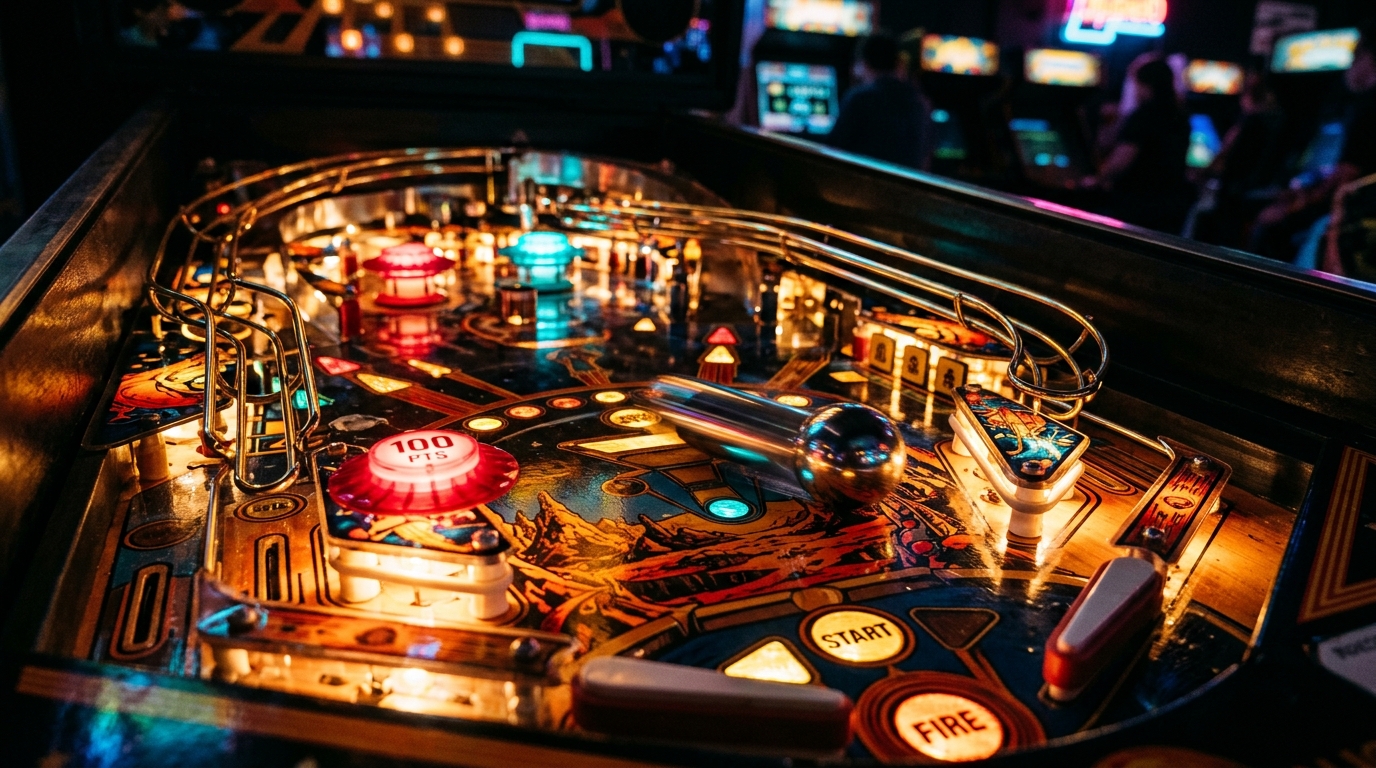
Close-up of a chrome steel pinball streaking across an illuminated wooden playfield with glowing amber and cyan bumpers
REAL PHYSICS UNDER GLASS UPDATED NOV 18, 2026

Not a Video Game.
80 Grams of Chrome Steel vs. Gravity & 50 Volts.

Maybe you’ve only ever fed quarters into that one worn-out machine in the corner of a pizza parlor, slapping both buttons at the same time and hoping the ball stays alive. Or maybe you already know the joy of a clean drop catch and a screaming jackpot callout. Either way—welcome home. This is your field guide to the machines, the mechanics, the outlaw history, the world rankings, and how to actually control the silverball.

1-1/16" Standard Carbon-Chrome Steel Ball (80g / 2.8 oz)
6.5° Standard Playfield Pitch Slope Toward the Drain
35 Years Banned as Contraband in NYC (1942–1976)
15+ Makers Building New Commercial Machines in 2026
INTERACTIVE 01 // CUSTOM HTML5 PHYSICS ENGINE

PLAY: “OUTLAW ’76: THE SHOT HEARD ’ROUND MANHATTAN”

A playable single-screen pinball table built from scratch in HTML5 Canvas with sub-stepped rigid-body ball physics, rotational flipper surface velocity transfer, 360° pop bumpers, a 3-bank drop target assembly, upper spinner lane, skill shot, and a real swinging plumb-bob tilt pendulum.

SCORE 000,000
HIGH SCORE 250,000
BALL 1 / 3
MULTI 1X
HOLD [SPACE] OR PLUNGE BUTTON TO LAUNCH BALL
TILT BOB:
02 // FROM VERSAILLES PARLORS TO PROHIBITION RAIDS

THE OUTLAW HISTORY & THE SHOT THAT SAVED PINBALL

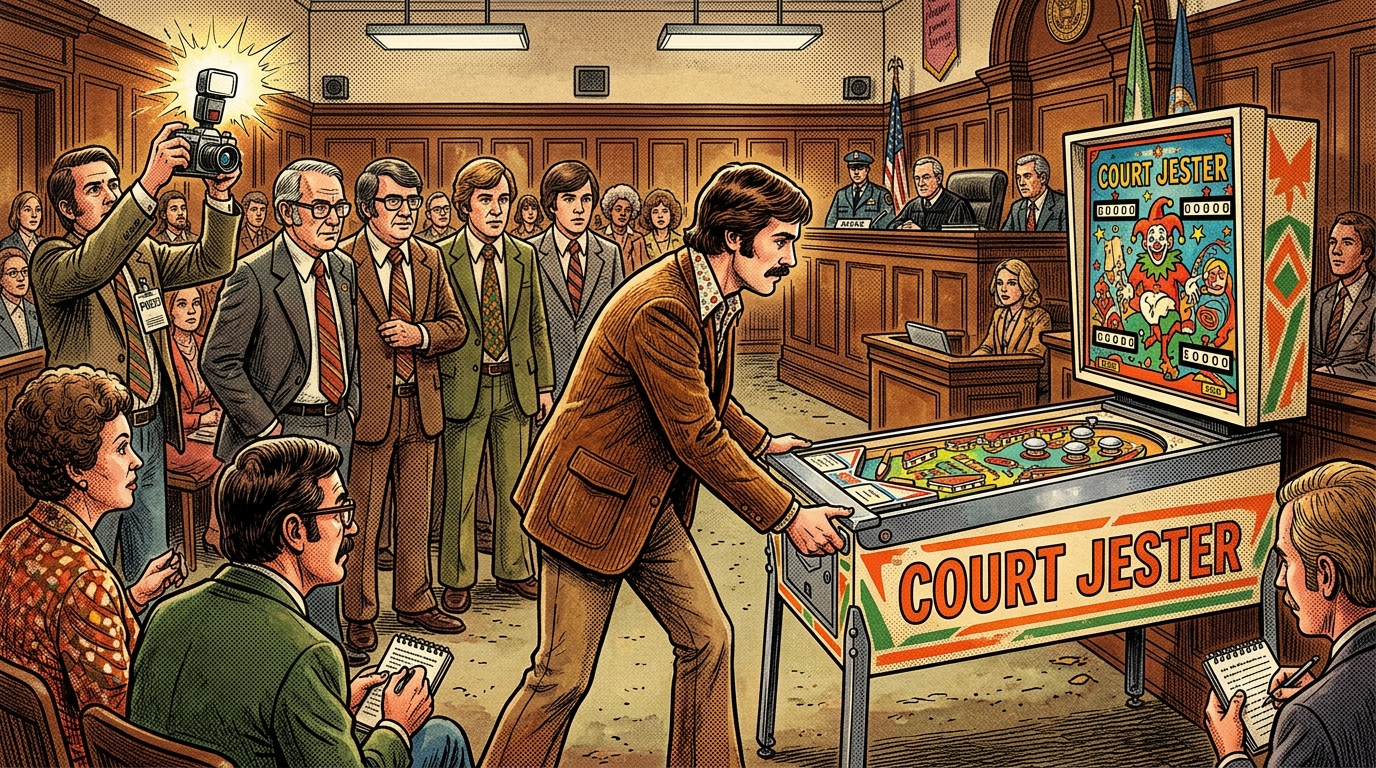
For 34 years, playing pinball in New York City, Los Angeles, or Chicago was a crime. Police smashed thousands of wooden cabinets with sledgehammers and dumped them into the Long Island Sound—until one mustachioed writer called his shot in a Manhattan courtroom.

1970s editorial illustration of Roger Sharpe leaning over a pinball machine in a Manhattan courtroom surrounded by council members and press photographers
April 2, 1976 — Manhattan City Hall: 28-year-old GQ writer Roger Sharpe steps up to a Gottlieb Bank Shot before the New York City Council Consumer Affairs Committee.
THE BABE RUTH MOMENT OF PINBALL

“If I pull the plunger back just right...”

When New York City Mayor Fiorello La Guardia banned pinball on January 21, 1942, pinball machines didn’t have flippers. You pulled a plunger, watched a ball bounce randomly down a field of brass pins, and hoped for a payout. Courts ruled it pure gambling—a mafia-run slot machine stealing kids’ lunch money and wasting wartime copper.

Even after Gottlieb engineer Harry Mabs invented electromechanical flippers on Humpty Dumpty in October 1947, the ban stayed on the books for nearly three more decades. By 1976, the industry hired 28-year-old journalist and crack player Roger Sharpe to testify in Room 16 of Manhattan City Hall.

“I’m going to plunge the ball, and if I pull the plunger back just right, the ball will—I hope—go up and through that particular center lane at the top of the playfield.” — Roger Sharpe testifying before the NYC Council, April 2, 1976

With television cameras rolling and flashbulbs popping, Sharpe released the spring plunger on a Gottlieb Bank Shot. The steel ball rolled straight down the exact center rollover lane he had pointed to. The committee voted unanimously (8–0) to repeal the 34-year ban, and cities across North America followed suit.

THE 250-YEAR EVOLUTION OF THE SILVERBALL

1777 – 1871

Château de Bagatelle & Montague Redgrave’s Spring Plunger

In 1777, King Louis XVI’s brother threw a party at Château de Bagatelle in Paris featuring a narrowed billiard table where players used cues to shoot ivory balls past brass pins into numbered holes. Nearly a century later, in 1871, Cincinnati inventor Montague Redgrave received U.S. Patent #115,357 for replacing the cue stick with a coiled spring plunger, shrinking the table, and swapping ivory spheres for marbles.

Defining Artifacts: French Parlor Bagatelle (1777) • Redgrave’s Improvements in Bagatelle Patent #115,357 (1871)
03 // UNDER THE HARDWOOD PLAYFIELD

HOW A PINBALL MACHINE ACTUALLY WORKS INSIDE

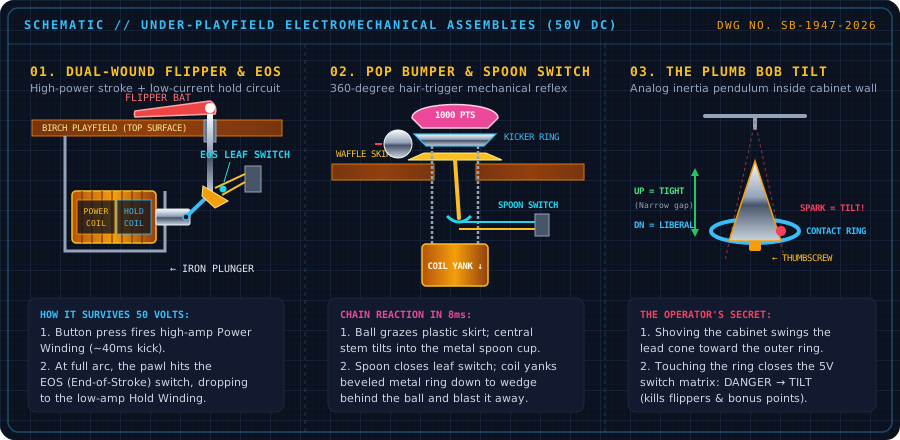
Lift the tempered glass and hinge up the birch playfield, and a pinball machine looks like the wiring harness of a 1960s jet fighter. Nearly a mile of wire connects microswitches to 50-volt DC copper solenoids that fire in under 10 milliseconds.

Technical schematic showing Dual-Wound Flipper Solenoid and EOS Switch, Pop Bumper and Spoon Switch, and Conical Plumb Bob Tilt mechanism
INTERACTIVE 02 // ELECTROMECHANICAL WORKBENCH

TEST THE 50V ASSEMBLIES UNDER THE PLAYFIELD

Switch between the three signature assemblies below and fire or adjust them in real time to see what happens underneath the wood.

Dual-Wound Flipper Solenoid & End-of-Stroke (EOS) Switch

A flipper needs violent torque to launch an 80-gram steel ball up a 6.5° slope—drawing nearly 4 amps at 50V DC. If that high-power coil stayed energized while you held the button to trap a ball, it would melt into smoke in seconds. So traditional coils have two windings: a thick Power Winding for the kick, and a fine Hold Winding. At the top of the stroke, the flipper crank physically opens the EOS leaf switch (or triggers a 40ms solid-state PWM cut-off), dropping current by 90%.

COIL STATE IDLE (0V)
CURRENT DRAW 0.0 Amps
SWITCH CIRCUIT EOS CLOSED
01 // SWITCH MATRIX & RULES

How a Game “Knows” Where the Ball Is

A modern playfield has 64 to 96 switches—wire rollovers, opto-interrupt beams, standup targets, and eddy-current magnetic sensors. Each switch lives on an 8×8 grid. Closing a switch doesn’t award the same points every time; the rules engine checks which Modes, Locks, and Multipliers you currently have lit.

02 // MODES & STACKING

Why Shooting Flashing Arrows Beats Random Flailing

In the pizza parlor, people just try not to drain. In real pinball, you shoot a key ramp or scoop to start a Mode—a 30-to-60-second mission with high-value jackpot shots. The secret to huge scores is Stacking: starting a timed Mode and immediately triggering a 3-ball Multiball so three balls are hunting mode jackpots at once.

03 // SLINGSHOTS & OUTLANES

The Danger Zone Above the Flippers

Those two triangular bumpers above the flippers are Slingshots. Their rubber bands close two hair-trigger leaf switches that kick the ball sideways—often straight toward the dreaded outer drain lanes (Outlanes). Learning to gently nudge the cabinet upward when the ball enters the slingshots keeps it out of the outlanes.

04 // THE WIZARD MODE

The Final Boss Under Glass

Pioneered by 1990s classics like Twilight Zone (“Lost in the Zone”) and Medieval Madness (“Battle for the Kingdom”), a Wizard Mode is the ultimate reward for completing every major objective on the playfield—unleashing a 6-ball frenzy, custom light shows, and hundreds of millions of points.

04 // PINSIDE TOP 100 & IPDB TOP 300 LEGENDS

THE MOST LOVED MACHINES & WHY THEY ENDURE

With over 4,000 pinball machines cataloged in the Internet Pinball Database (IPDB), a handful of tables stand tall as consensus masterpieces across both 1990s Bally/Williams Golden-Age collectors and modern Stern/JJP/Spooky players. Filter the pantheon below or inspect each machine’s signature shot.

PINSIDE #1 ALL-TIME (9.17) Stern • 2021

Godzilla

Designed by Keith Elwin • Art by Zombie Yeti • Code by Rick Naegele

Designed by the greatest tournament player in history (Keith Elwin), Godzilla dethroned 25 years of 1990s nostalgia through sheer kinetic flow. On the Premium/LE models, a motorized skyscraper physically collapses mid-game to reroute both ramps onto its roof, while a magnetic Suspension Bridge grabs and flings steel balls across the playfield.

Signature Shot: Left Spinner through the collapsing upper building into the floating upper-left flipper loop.
PINSIDE #2 • IPDB #2 Williams • 1997 / CGC Remake

Medieval Madness

Designed by Brian Eddy • Code by Lyman Sheats • Voices incl. Tina Fey

The quintessential “walk up and immediately get it” table. Anyone who has only played in a pizza parlor knows what to do the second they see the motorized drawbridge lower and the castle towers explode when hammered with the ball. Paired with two pop-up playfield trolls and hilarious Second City comedy writing, it never gets old.

Signature Shot: Dead-center shot straight up the drawbridge gate to physically blow apart the castle walls.
IPDB #1 ALL-TIME Bally • 1993

Twilight Zone

Designed by Pat Lawlor • Code by Ted Estes • Art by John Youssi

After designing The Addams Family, Pat Lawlor was given a blank check by Bally. The result is an audacious widebody packed with wonders: a working mechanical gumball machine that randomly spits out a white ceramic Powerball (lighter than steel, non-magnetic, and terrifyingly fast), a mini playfield controlled by invisible pulsed electromagnets instead of flippers, and an analog clock.

Signature Shot: The Camera & Piano scoops during ceramic Powerball Mania, building toward “Lost in the Zone.”
IPDB #4 • PINSIDE TOP 10 Bally • 1995 / CGC Remake

Attack from Mars

Designed by Brian Eddy • Code by Lyman Sheats • Sound by Dan Forden

The pure distillation of the “fan layout” (symmetrical ramps, orbits, and a central bash target). With nothing cluttering the lower two-thirds of the playfield, every shot is visible from both flippers. Shaking rubber Martians, a UFO surrounded by mini saucers, and the legendary dark-room Strobe Multiball make it an all-time rush.

Signature Shot: Rapid-fire center Forcefield bash shots while four rubber Martians jump up and down on the playfield.
BEST-SELLING PIN EVER (20,270 UNITS) Bally • 1992

The Addams Family

Designed by Pat Lawlor & Larry DeMar • Voices by Raul Julia

If you played pinball in a 1990s pizza place, bowling alley, or college student union, it was probably The Addams Family. Selling an unmatched 20,270 cabinets, it introduced “Thing” (a mechanized hand that rises out of a box to grab your ball), three hidden under-playfield magnets (“The Power”) that randomly whip the ball sideways, and Raul Julia’s unforgettable “SHOWTIME!” multiball intro.

Signature Shot: Upper-left flipper Swamp lock that triggers Thing’s mechanical hand to snatch the silverball.
PINSIDE #3 ALL-TIME Stern • 2019

Jurassic Park

Designed by Keith Elwin • Code by Rick Naegele

A shooter’s dream built for high-level precision. Using four flippers, it asks you to navigate Isla Nublar to rescue staff and capture dinosaurs before escaping the island. Features a motorized T-Rex head that physically swallows the steel ball in its jaws and throws it across the playfield, plus a spinning helicopter kinetic spinner.

Signature Shot: Backhanding the Control Room or threading the upper-right flipper through the Raptor Tower loop.
PINSIDE TOP 6 Stern • 2024

Jaws

Designed by Keith Elwin • Callouts by Richard Dreyfuss • Music by John Williams

Blends modern deep rules with the moody suspense of 1970s cinema. Features a horizontal “Chum Line” Newton-ball target, a spinning fishing reel horizontal spinner, an upper playfield modeled after Quint’s Orca boat deck, and a Great White shark that breaches through a Motorized wave ramp to smash the boat cage.

Signature Shot: Firing the harpoon lane after slapping the kinetic Chum Bucket across the center of the water.
RETRO SINGLE-LEVEL MASTERCLASS Chicago Gaming Co. / Play Mechanix • 2023

Pulp Fiction

Designed by Mark Ritchie • Code by Josh Sharpe

Proof that you don’t need an LCD television in the backbox to make a modern masterpiece. Designed by 1980s legend Mark Ritchie (Fish Tales, Taxi), Pulp Fiction strips away wireform ramps in favor of a blisteringly fast 1980s single-level playfield with drop target banks, glowing briefcase light shows, and an inline Pawn Shop captive ball.

Signature Shot: Ripping the center glowing Briefcase spinner and sweeping the 5-bank drop targets under time pressure.
05 // FACTORIES FROM ELK GROVE VILLAGE TO EUROPE

THE MAKERS STILL BUILDING THEM TODAY

In 1999, when Williams shut down its pinball division, only one company on Earth was left standing (Stern). Today, in late 2026, pinball is in a golden renaissance with over a dozen factories building brand-new commercial machines.

ELK GROVE VILLAGE, ILLINOIS • EST. 1986

Stern Pinball

The undisputed heavyweight of the industry. Stern carried pinball on its back through the lean 2000s and now runs a sprawling factory building Pro, Premium, and Limited Edition tiers linked by the Insider Connected QR-code achievement network.

Notable Tables: Godzilla, Jaws, Jurassic Park, Foo Fighters, The Uncanny X-Men, Dungeons & Dragons: The Tyrant’s Eye, King Kong: Myth of Terror Island
sternpinball.com — Official lineups, factory tours & Insider Connected leaderboards ↗
ELK GROVE VILLAGE, ILLINOIS • EST. 2011

Jersey Jack Pinball (JJP)

Founded by industry veteran Jack Guarnieri, JJP sparked the modern boutique boom by introducing full-color LCD backbox displays, RGB LED lightshows, and lavish widebody cabinets packed with physical toys.

Notable Tables: Elton John, Harry Potter, Avatar: The Battle for Pandora, Guns N’ Roses, Dialed In!, The Wizard of Oz
jerseyjackpinball.com — Widebody collector editions & rules sheets ↗
BENTON, WISCONSIN • EST. 2013

Spooky Pinball

A family-born boutique factory in small-town Wisconsin that grew from a podcast dream into a powerhouse of cult-classic and horror pinball—famous for wild sculptural mechs, butter-cabinet artwork, and passionate customer service.

Notable Tables: Evil Dead (Pinside Top 5!), Texas Chainsaw Massacre, Looney Tunes, Scooby-Doo, Halloween
spookypinball.com — Boutique horror & cult-classic builds from Wisconsin ↗
CICERO, ILLINOIS • EST. 2013 (PINBALL)

Chicago Gaming Company (CGC)

Partnering with design studio Play Mechanix, CGC built its reputation on museum-grade modernized remakes of 1990s Bally/Williams legends before stunning the community with original designs like Pulp Fiction.

Notable Tables: Medieval Madness Remake, Attack from Mars Remake, Monster Bash Remake, Cactus Canyon Remake, Pulp Fiction
chicagogaming.com — Official Bally/Williams remakes & Pulp Fiction ↗
PALATINE, IL • ROUND ROCK, TX • UT • EUROPE

American Pinball, Multimorphic, Turner & Euro Makers

American Pinball builds original themes (Galactic Tank Force, Hot Wheels); Multimorphic makes the modular P3 Platform with swap-in playfield modules (Portal, The Princess Bride); Turner Pinball crafts value-packed originals (Ninja Eclipse, Merlin’s Arcade); and European studios Pinball Brothers / Pedretti Gaming (Alien, ABBA, FunHouse) and Dutch Pinball (The Big Lebowski) keep global engineering thriving.

06 // INTERACTIVE 03: THE FLIPPER SKILLS DOJO

HOW TO ACTUALLY GET BETTER AT PINBALL

The #1 difference between a beginner in a pizza shop and a competitive player isn’t faster reflexes—it’s slowing the game down. Instead of slapping at a moving ball, great players catch the ball, trap it in a cradle, transfer it to the flipper that has the shot, and aim with the geometry of the bat.

SELECT A TECHNIQUE TO SIMULATE

01. The Dead Bounce (Dead Flip)

Difficulty: ★☆☆☆ (Start Here Tonight!)

HOW TO EXECUTE IT

When a ball drops vertically from an orbit, ramp, or pop bumper toward your right flipper, keep your hands completely off the buttons. Let the ball hit the urethane rubber of the resting right flipper. It will absorb half the energy and bounce in a clean, predictable arc right onto your left flipper—ready to trap or shoot!

WHEN TO USE IT & WATCH TUTORIAL

Use whenever a ball comes down at a steep vertical angle and you actually want the ball on the opposite flipper. It is the safest, highest-percentage move in all of pinball.

▶ Watch Abe Flips’ Slow-Motion Breakdown on YouTube ↗
RULE #1

One Flipper at a Time

Flipping both buttons together opens a giant drain window and ruins your visual timing. Only flip the side the ball is actually approaching.

RULE #2

Early = Backhand / Late = Cross-Court

A ball rolling down an inlane travels from the base of the flipper to the tip. Flip early to shoot straight up the same side; wait a split-second to shoot across the table.

RULE #3

Look at the Flashing Lights, Not the Ball

Once a ball is trapped on your held flipper, look up at the playfield inserts. Flashing arrows tell you where the jackpots and ball locks are waiting.

07 // THE SPORT OF SILVERBALL • IFPA & WPPR v6.x

COMPETITIVE PINBALL & WORLD RANKINGS (WPPR)

Over 130,000 ranked players compete in more than 10,000 sanctioned tournaments every year—from Tuesday night brewery leagues to the IFPA World Pinball Championship and INDISC. Here is how the global ranking system works and how you can play your first event this week.

What is the IFPA & What are “Whoppers”?

The International Flipper Pinball Association (IFPA) is the world governing body of competitive pinball. Every time you play in an IFPA-sanctioned league or tournament—even if you finish dead last—you earn an official player profile and World Pinball Player Rankings (WPPR) points, affectionately pronounced “Whoppers.”

  • Rolling 3-Year Window: Your world rank is calculated from your top 20 active tournament finishes over the past 3 years (older results decay by 25% after 1 year and 50% after 2 years).
  • Strength of Field & TGP: A tournament’s point pool depends on how many players enter, how high-ranked those players are, and the Tournament Grading Percentage (TGP)—which measures how many meaningful games of pinball are played (4% per meaningful game up to 100%, boosted for head-to-head finals).
  • Zero Barrier to Entry: Most local weekly bar/arcade tournaments cost $5 to $10 plus coin drop, use software like Match Play Events on your phone to text you your group assignments, and welcome first-timers with open arms.
INTERACTIVE WPPR POINT ESTIMATOR

Estimate Your Tournament WPPR Haul

Slide the parameters below to see how field size, format length (TGP), and finishing position shape your IFPA World Ranking points.

ESTIMATED WPPR EARNED
28.40 WPPR
Equivalent to winning a strong regional monthly or 100%-TGP match-play event.

Group Match Play (7-5-3-1)

The friendly gold standard: 4 players play a machine together. 1st gets 7 pts, 2nd gets 5, 3rd gets 3, 4th gets 1. After 5–7 rounds, top scorers make finals.

3-Strike / 4-Strike Knockout

Play in 4-player groups; the bottom two scores each round receive a strike. Get 3 strikes and you’re eliminated—last player standing wins.

Flip Frenzy

Non-stop action for a set clock (e.g., 2.5 hours): play head-to-head games continuously against a live queue. When your game ends, you immediately get paired again.

Pin-Golf

Each machine has a target score or specific mode objective (“Par”). Reach the target score on Ball 1 for a Hole-in-One! Lowest total strokes across 9 or 18 machines wins.

08 // BOOKMARK THIS // EVERY LINK OPENS IN A NEW TAB

THE PINBALL FIELD DIRECTORY

Pinball thrives because of an obsessive, generous community of volunteer archivists, location mappers, rule-sheet writers, tutorial filmmakers, and streamers. Every single link below was hand-picked—with a one-line breakdown of why it is worth your click.